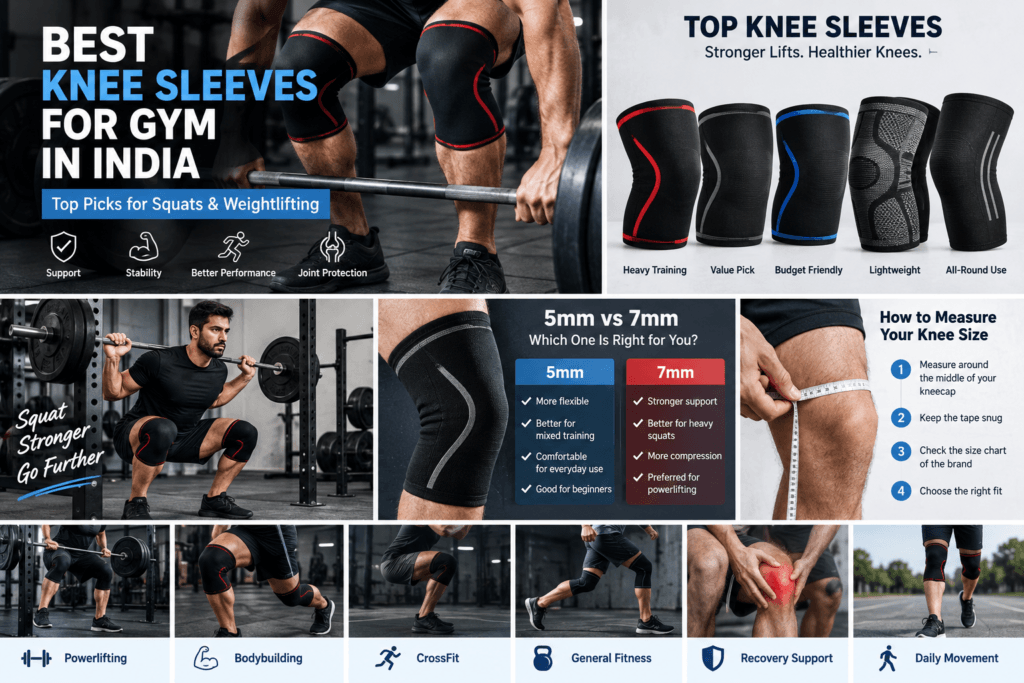
Best Knee Sleeves for Gym in India – Quick Answer
If you regularly perform squats, leg presses, lunges or heavy lower-body workouts, a good knee sleeve can provide compression, warmth and a more secure feeling around the knee.
For serious strength training, 7mm neoprene knee sleeves are usually the better choice when maximum compression and stiffness are priorities. For general gym workouts, CrossFit-style training, running or mixed workouts, a 5mm or lighter compression sleeve can be more comfortable.
Our top picks
| Knee Sleeve | Best For | Thickness | Price Range* |
|---|---|---|---|
| Neoprene 7Mm Thick Heavy-Duty Professional Knee | Heavy squats & strength training | 7mm | ₹1,200–₹1,500 |
| Leosportz 7mm Knee Sleeves | Value 7mm option | 7mm | ₹900–₹1,300 |
| Boldfit Classic Knee Sleeve | Budget/general gym use | Compression fabric | ₹300–₹600 |
| NIVIA Super Soft Knee Support | Lightweight training | Compression fabric | ₹400–₹700 |
| Kobo 7mm Knee Sleeves | Budget heavy training | 7mm | ₹700–₹1,000 |
| RACE 7mm Knee Sleeves | Powerlifting-style training | 7mm | ₹3500–₹4,000 |
*Prices change frequently depending on size, colour, seller and ongoing discounts.
Our quick recommendation: If your main goal is heavy squats and strength training, start with a 7mm neoprene sleeve. If you want something lighter and more comfortable for everyday gym sessions, choose a thinner compression sleeve.
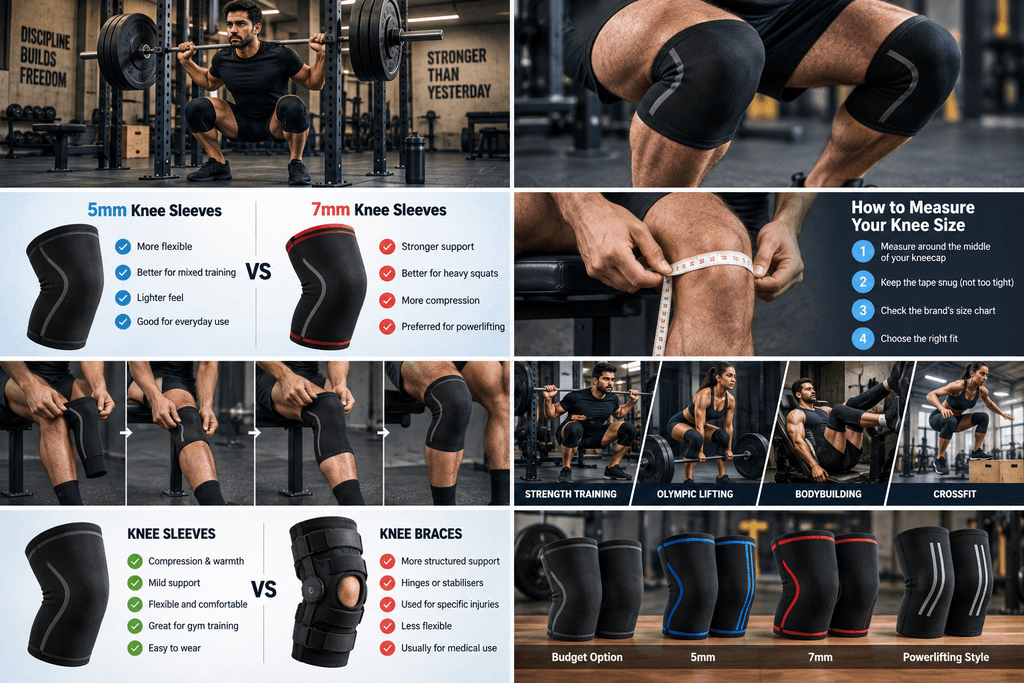
What Are Knee Sleeves?
Knee sleeves are stretchy supports worn around the knee during exercise. They are commonly made from neoprene or elastic compression fabrics.
Unlike knee wraps, sleeves are designed to stay around the knee throughout the exercise. They can provide:
- Compression around the joint
- Warmth during training
- A more secure feeling while squatting
- Some resistance to movement at the bottom of a squat
- Protection from minor friction and contact
- Extra comfort during lower-body workouts
However, knee sleeves should not be confused with medical knee braces.
A typical gym knee sleeve is a training accessory, not a treatment for a knee injury.
Research on neoprene sleeves is still relatively limited, but some studies have found improvements in perceived stability and, in certain squat tests, maximal performance. Other research has found little or no effect on high-volume leg-press performance. So it is better to think of sleeves as a support and comfort accessory rather than a magic performance enhancer.
Best Knee Sleeves for Gym in India
1. 7mm Thick Heavy-Duty Professional Knee Workout
Why we like it
If your priority is heavy squats, power lifting and serious strength training, 7mm Thick Heavy-Duty Professional Knee Workout are one of the stronger options available in India.
The current model uses 7mm construction and reinforced stitching, and the manufacturer offers multiple sizes from XS through XXL. The product is specifically positioned for weightlifting, power lifting and CrossFit.
The thicker construction gives the sleeve a noticeably more supportive and restrictive feel compared with lightweight compression sleeves.
Key features
- 7mm construction
- Heavy-duty design
- Reinforced stitching
- Compression fit
- Available in multiple sizes
- Designed for weightlifting and power lifting
- Sold as a pair
Pros
- Excellent choice for heavy squats
- Thick construction
- Strong compression
- Suitable for strength-focused training
- Multiple size options
Cons
- Can feel too restrictive for cardio
- More difficult to put on than thin sleeves
- Not necessary for casual gym workouts
Best for
Powerlifters, serious lifters and people who prioritise heavy squats.
Verdict: ⭐ Best overall for heavy strength training
Limited deals available Buy Now
2. Leosportz 7mm Knee Support Sleeves – Best Value 7mm
If you want the feel of a traditional 7mm knee sleeve without moving into premium pricing, the Leosportz 7mm model is worth considering.
The current product is sold as a pair and uses 7mm neoprene with reinforced stitching. Leosportz recommends measuring the circumference around the middle of the kneecap before selecting a size.
The product is designed specifically for gym workouts, squats, deadlifts, CrossFit and strength training.
Key features
- 7mm neoprene
- Reinforced stitching
- Ergonomic sleeve design
- Compression fit
- Sold as one pair
- Multiple sizes
- Designed for squats and strength training
Pros
- Good 7mm option
- Strong compression
- Suitable for heavy lower-body training
- Pair included
- Relatively affordable
Cons
- Thick sleeves can feel warm
- Not ideal for running
- Correct sizing is important
Best for
Gym users who want a 7mm sleeve without spending too much.
Verdict: ⭐ Best value 7mm knee sleeve Buy Now
3. Boldfit Classic Knee Sleeve – Best Budget Pick
Not everyone needs a stiff 7mm power lifting sleeve.
If you mainly want light compression, warmth and general knee support during gym sessions, the Boldfit Classic Knee Sleeve is a more affordable option.
The current Boldfit model uses a nylon and latex blend and is designed around lightweight compression. It also has internal silicone strips intended to help keep the sleeve in place during movement.
Key features
- Lightweight design
- Compression fit
- Nylon and latex blend
- Breathable stretch fabric
- Silicone anti-slip strips
- Moisture-wicking construction
- Available in S, M, L and XL
Pros
- Affordable
- Lightweight
- Easier to wear than thick neoprene sleeves
- Suitable for general workouts
- Anti-slip design
Cons
- Not as supportive as a stiff 7mm sleeve
- Not our first choice for heavy power lifting
- Less rebound than thick neoprene
Best for
Beginners, general gym training and people who dislike bulky knee sleeves.
Verdict: ⭐ Best budget knee sleeve for general gym use
Buy With Best Price
4. NIVIA Super Soft Knee Support – Best Lightweight Option
For users who want something light, breathable and flexible, NIVIA’s Super Soft Knee Support is a useful alternative to heavy neoprene sleeves.
The current product is available in several sizes and is marketed for sports and training. NIVIA describes it as a lightweight compression support with moisture-wicking and quick-drying characteristics.
This type of sleeve makes more sense for mixed workouts where you don’t want the stiffness of a 7mm power lifting sleeve.
Key features
- Lightweight construction
- Compression support
- Breathable design
- Quick-drying fabric
- Multiple sizes
- Designed for sports and gym use
Pros
- Comfortable for longer sessions
- Lightweight
- Good mobility
- Suitable for mixed training
- Relatively affordable
Cons
- Less rigid than 7mm neoprene
- Not designed specifically for maximum squat support
- Compression feel depends on sizing
Best for
General gym workouts, mixed training and people who prioritise mobility.
Verdict: ⭐ Best lightweight knee support
Check Best Price
5. Kobo 7mm Knee Sleeves – Budget Heavy-Training Option
Kobo’s 7mm knee sleeve is another option aimed at users looking for a thicker sleeve for squats, weightlifting and power lifting-style training.
Current Indian marketplace listings describe the product as a 7mm neoprene knee sleeve designed for gym workouts, squats and other sports activities.
Key features
- 7mm construction
- Neoprene material
- Compression design
- Designed for gym and strength training
- Available in multiple sizes
Pros
- Thick construction
- Suitable for heavy training
- Budget-friendly compared with premium imported sleeves
Cons
- Fit can vary between brands
- Check seller and size information carefully
- Less suitable for high-mobility workouts
Best for
Budget-conscious lifters who specifically want a thicker sleeve.
Verdict: ⭐ Worth considering for budget 7mm training
Limited Deal Buy Now
6. RACE 7mm Knee Sleeves – For Powerlifting-Style Training
RACE also offers 7mm knee sleeves marketed toward power lifting, squats and weightlifting. Current Indian listings describe the product as a heavy-duty neoprene sleeve with compression and anti-slip features.
Key features
- 7mm thickness
- Neoprene construction
- Compression support
- Designed for squats and weightlifting
- Available for men and women
Pros
- Thick and supportive
- Suitable for strength training
- Good option for lifters looking for 7mm sleeves
Cons
- Can be restrictive
- Not necessary for beginners
- Always check current seller, size and return policy
Best for
Lifters who prefer a firm 7mm sleeve for heavy lower-body sessions.
CHeck Price on amazon
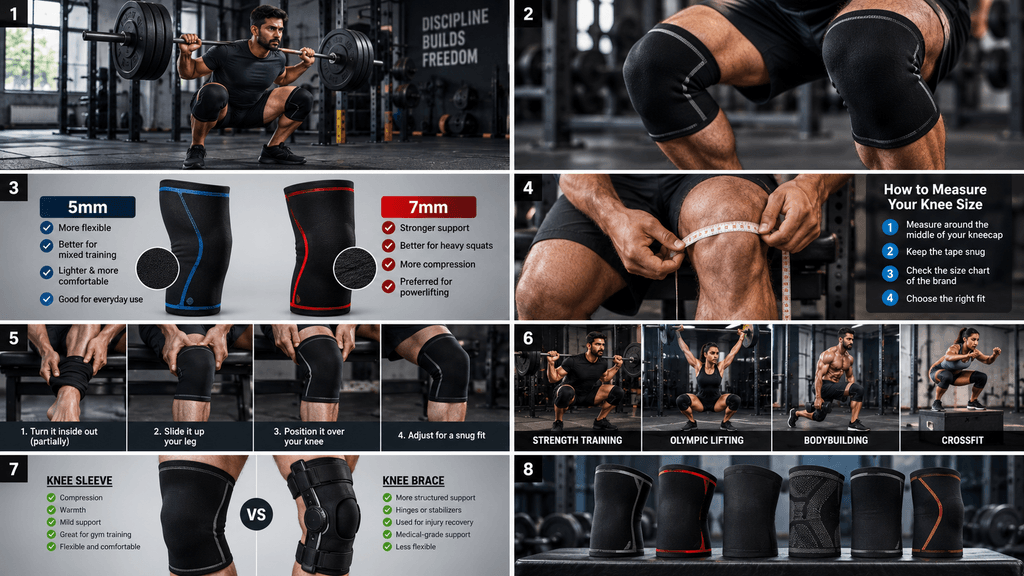
5mm vs 7mm Knee Sleeves: Which Should You Buy?
This is one of the most important decisions when buying knee sleeves.
A common mistake is assuming that 7mm is automatically better than 5mm.
It isn’t.
The correct thickness depends on your training style.
| Feature | 5mm Knee Sleeve | 7mm Knee Sleeve |
|---|---|---|
| Compression | Moderate | High |
| Warmth | Moderate | High |
| Mobility | Better | More restricted |
| Stiffness | Lower | Higher |
| Squat support | Good | Excellent |
| CrossFit | Better suited | Can feel restrictive |
| Running | More suitable | Usually too restrictive |
| Heavy squats | Good | Excellent |
| Powerlifting | Good | Preferred |
| Ease of wearing | Easier | Harder |
| Best for | Mixed training | Heavy strength training |
Choose 5mm if:
- You do mixed workouts
- You perform CrossFit-style movements
- You want more mobility
- You dislike very tight sleeves
- You also run or do conditioning
- You want everyday knee warmth
Choose 7mm if:
- Squats are a major part of your training
- You regularly lift heavy
- You train for strength
- You do power lifting
- You prefer firm compression
- You want maximum sleeve stiffness
Current research suggests neoprene sleeves can influence squat performance in some circumstances, but they don’t consistently improve every aspect of lower-body performance.
Bottom line: Don’t buy 7mm simply because it sounds more “professional.” Buy it because your training actually benefits from a stiffer sleeve.
Are Knee Sleeves Good for Squats?
Yes, they can be useful during squats.
A good knee sleeve can provide:
- Warmth around the knee
- Compression
- A more secure feeling
- Some resistance as the knee bends
- Better comfort for some lifters
Research has found that neoprene knee sleeves can improve 1RM squat performance in certain controlled settings, although the effect isn’t universal across different exercises and training conditions.
A 2024 exploratory study involving 7mm sleeves and CrossFit athletes also found improved perceived knee stability and an increase in front-squat 1RM when sleeves were worn. However, the researchers described the biomechanical effects as relatively small.
So don’t expect a knee sleeve to suddenly add 20 kg to your squat.
Your biggest improvements will still come from:
- Better technique
- Progressive overload
- Proper programming
- Adequate recovery
- Strong quads, hamstrings and glutes
Do Knee Sleeves Prevent Knee Injuries?
This is where you should be careful.
Knee sleeves should not be considered an injury-prevention guarantee.
They can provide compression and warmth and may make the knee feel more stable, but wearing a sleeve doesn’t automatically make poor technique, excessive training volume or inappropriate loading safe.
Some studies have investigated changes in movement and neuromuscular control with neoprene sleeves, but the evidence isn’t strong enough to say that ordinary gym sleeves prevent injuries.
If you already have:
- Significant knee pain
- Swelling
- Instability
- A diagnosed knee injury
- Locking or catching
- Pain that continues outside training
a gym sleeve shouldn’t be your substitute for professional assessment.
Knee Sleeves vs Knee Braces
These are different products.
Knee sleeves
Usually provide:
- Compression
- Warmth
- Mild support
- Comfort during training
Knee braces
Can provide:
- More structured support
- Adjustable straps
- Hinges or stabilising components
- Support for specific medical or rehabilitation needs
A normal gym sleeve isn’t designed to replace a medical brace.
If you’re buying a product specifically because you have a knee injury, choose the appropriate support based on professional advice rather than simply buying the thickest sleeve.
Knee Sleeves vs Knee Wraps
Don’t confuse these two.
Knee sleeves
- Slip over the knee
- Provide consistent compression
- Easier to use
- Suitable for regular gym training
- Usually made from neoprene or compression fabric
Knee wraps
- Wrapped around the knee
- Can create substantially more tension
- More technique-dependent
- Common in power lifting
- Usually used specifically for heavy squatting
For normal gym users, knee sleeves are usually the simpler choice.
If you compete in power lifting, check your federation’s current equipment rules.
For example, the 2026 IPF Technical Rules specify that competition knee sleeves must meet specific requirements, including a maximum thickness of 7mm and maximum length of 30cm, and only approved manufacturers/products are permitted.
Therefore, don’t assume that a product advertised as “IPF approved” on a marketplace automatically meets the rules for your particular competition. Always verify the current federation-approved list.
How Tight Should Knee Sleeves Be?
This is probably the most important part of buying knee sleeves.
Your sleeve should be snug and secure without causing excessive discomfort, numbness or circulation problems.
It shouldn’t:
- Slide down repeatedly
- Fold behind your knee excessively
- Cause numbness
- Cause tingling
- Make your foot or lower leg feel unusually cold
- Cause significant pain
At the same time, a sleeve that slides on extremely easily may not provide the compression you’re looking for.
How to measure
The exact sizing method depends on the manufacturer.
Some brands ask you to measure:
Knee circumference around the middle of the kneecap.
For example, Leosportz specifically instructs customers to measure around the mid-patella with a flexible tape.
Other brands may use different measurements.
Important:
Never assume that Medium from one brand equals Medium from another brand.
Always check the manufacturer’s sizing chart before ordering.
How to Put On Tight 7mm Knee Sleeves
7mm sleeves can be difficult to put on, especially when new.
Here’s a simple method.
Step 1: Turn the sleeve partially inside out
Fold the upper portion down.
Step 2: Place it below the knee
Position the sleeve around the lower part of your leg.
Step 3: Pull it upward gradually
Work the material up instead of trying to pull the entire sleeve at once.
Step 4: Position the knee
The sleeve should sit centrally around the knee joint.
Step 5: Smooth the material
Remove major folds or bunching.
Pro tip
Don’t aggressively pull a sleeve using only the edge of the material. This can put unnecessary stress on the stitching.
How to Use Knee Sleeves for Squats
For most lifters, knee sleeves don’t need to be worn for every exercise.
You can use them during:
- Back squats
- Front squats
- Hack squats
- Leg press
- Lunges
- Bulgarian split squats
- Heavy leg sessions
For lighter exercises, you may not need them.
Example leg-day setup
Warm-up:
5–10 minutes of general movement
↓
Bodyweight squats
↓
Empty-bar squats
↓
Progressively heavier warm-up sets
↓
Put on your knee sleeves
↓
Working sets
This approach allows you to warm up naturally before moving into heavier work.
Should You Wear Knee Sleeves for Every Workout?
No.
There is nothing wrong with using knee sleeves frequently if they’re comfortable, but they aren’t mandatory for every workout.
You might choose to use them for:
- Heavy squat days
- High-volume leg training
- Strength-focused sessions
- Exercises where you prefer the extra warmth
You might skip them for:
- Upper-body training
- Light cardio
- Walking
- Mobility work
- Exercises where they interfere with movement
Think of knee sleeves as training equipment, not something you have to wear every time you enter the gym.
Do Knee Sleeves Increase Squat Strength?
Possibly, but don’t exaggerate the effect.
One controlled study found that neoprene knee sleeves improved 1RM squat performance compared with a minimally supportive control sleeve, while other tested measures such as leg-extension performance and several power variables did not improve.
That means a sleeve may help you perform a maximal squat under certain conditions, but this doesn’t mean it directly makes your muscles stronger.
The difference may come from factors such as:
- Compression
- Warmth
- Stability
- Confidence
- Mechanical resistance from the sleeve
So the correct expectation is:
Knee sleeves may help your squat feel more secure and may improve performance slightly in some situations — but they aren’t a replacement for getting stronger.
Common Mistakes When Buying Knee Sleeves
1. Buying 7mm just because it’s thicker
Thicker doesn’t automatically mean better.
If you do CrossFit, running or mixed training, a 5mm sleeve may be more practical.
2. Choosing the wrong size
A poor fit can make even a high-quality sleeve uncomfortable.
Always use the manufacturer’s sizing chart.
3. Comparing prices without checking the quantity
Some products are sold as:
- One sleeve
- One pair
Always check the listing carefully.
A ₹700 listing for one sleeve isn’t necessarily cheaper than a ₹1,200 listing that includes a pair.
4. Expecting injury protection
A knee sleeve doesn’t make bad squat technique safe.
5. Wearing a sleeve that’s painfully tight
Compression is useful.
Pain, numbness or circulation problems aren’t.
6. Buying a medical brace for ordinary gym training
A brace and a compression sleeve serve different purposes.
7. Ignoring the return policy
Sizing can be tricky.
Before ordering, check:
- Return eligibility
- Exchange policy
- Size exchange conditions
- Whether the product must remain unused
This is particularly important with compression products.
How to Choose the Best Knee Sleeves in India
Before buying, check these eight factors.
1. Thickness
5mm: better for mixed training.
7mm: better for heavy strength training.
2. Material
Neoprene is popular because it provides compression, warmth and structure.
Light compression sleeves often use nylon, latex or similar stretch fabrics.
3. Fit
A knee sleeve should stay in place without becoming painfully tight.
4. Length
Longer sleeves provide more coverage around the knee area.
If you’re competing, check your federation’s rules.
5. Stitching
Look for reinforced seams if you plan to use the sleeves regularly for heavy training.
6. Anti-slip design
Silicone grip strips can help prevent the sleeve from sliding during movement.
Boldfit’s current Classic Knee Sleeve, for example, uses internal silicone strips to help keep the sleeve in position.
7. Ease of putting them on
Very tight 7mm sleeves can be difficult to put on.
If you train alone and don’t want to spend several minutes getting ready for each squat session, a lighter sleeve may be more practical.
8. Price
For most Indian gym users, there’s no need to spend several thousand rupees immediately.
A reasonable starting point is:
Under ₹500
Basic compression sleeves.
₹500–₹1,000
Better-quality everyday sleeves and some budget 7mm options.
₹1,000–₹1,500
More serious 7mm training sleeves.
₹1,500+
Premium/imported options and specialised competition-focused products.
Knee Sleeves for Different Types of Gym Users
Best knee sleeves for beginners
Choose a lightweight compression sleeve.
You probably don’t need an extremely stiff 7mm sleeve when you’re still learning squat technique.
Best knee sleeves for bodybuilding
A 5mm or moderate-compression sleeve can be a good choice.
Bodybuilders often perform a wide range of exercises, so mobility and comfort can matter more than maximum stiffness.
Best knee sleeves for power lifting
Choose a 7mm neoprene sleeve if your training revolves around heavy squats.
Best knee sleeves for CrossFit
A 5mm sleeve is often more practical because CrossFit combines squatting with jumping, running and other dynamic movements.
Best knee sleeves for leg day
Either 5mm or 7mm can work.
Choose based on how heavy and strength-focused your leg training is.
Are Knee Sleeves Worth It?
For the right person, yes.
They’re particularly useful if you:
- Squat regularly
- Train legs heavily
- Like compression
- Prefer warm knees during training
- Want a more secure feeling during squats
- Participate in strength training
But they’re not essential equipment.
If you’re a beginner with a limited budget, your money may be better spent first on:
- Good training shoes
- Proper gym equipment
- A sensible training programme
- Nutrition
- Recovery
- Then supportive accessories
A knee sleeve should complement good training, not replace it.
Frequently Asked Questions
Which are the best knee sleeves for gym in India?
For heavy strength training, Neoprene 7Mm Thick Heavy-Duty Professional Knee and Leosportz 7mm are two strong options to consider. For lighter everyday training, Boldfit Classic and NIVIA Super Soft are more comfortable choices.
Are 7mm knee sleeves better than 5mm?
Not necessarily.
7mm sleeves are thicker, stiffer and generally better suited to heavy squats and power lifting. 5mm sleeves provide more mobility and can be better for mixed training.
Are knee sleeves good for squats?
Yes. They can provide compression, warmth and a more stable feeling around the knee. Some research has also found improvements in 1RM squat performance under specific testing conditions.
Can knee sleeves prevent injuries?
You shouldn’t rely on knee sleeves to prevent injuries.
They may provide support and warmth, but they don’t correct poor technique or inappropriate training loads.
Can I wear knee sleeves for running?
You can, but thick 7mm sleeves may feel unnecessarily restrictive.
For running or mixed cardio training, a lighter compression sleeve is generally more practical.
Can I wear knee sleeves all day?
They’re primarily designed for training rather than continuous all-day use.
If a sleeve causes numbness, tingling, unusual swelling or significant discomfort, remove it.
Do knee sleeves make your squat stronger?
They may improve squat performance in some situations, but they’re not a substitute for developing strength. Research has shown some improvement in maximal squat performance, while other lower-body performance measures showed no significant improvement.
Should beginners use knee sleeves?
Yes, beginners can use them, but they don’t need an expensive 7mm sleeve just because they’re starting to squat.
Learn proper technique first.
What size knee sleeves should I buy?
Follow the manufacturer’s sizing chart.
Different brands use different measurements, so don’t assume that the same size will fit every brand.
Are knee sleeves and knee braces the same?
No.
Knee sleeves primarily provide compression and warmth, while braces can provide more structured support and may be designed for specific injuries or rehabilitation needs.
How long do knee sleeves last?
It depends on the material, frequency of use, washing and how aggressively they’re put on.
Heavy 7mm sleeves can last for a long time when cared for properly, but stitching and elasticity eventually deteriorate.
Can knee sleeves replace knee wraps?
No.
They serve different purposes. Knee wraps can provide much more aggressive support and are commonly associated with heavy power lifting.
Are 7mm knee sleeves allowed in power lifting?
The answer depends on the federation.
Under the 2026 IPF rules, competition knee sleeves can be a maximum of 7mm thick and 30cm long, with additional construction and manufacturer-approval requirements.
Always check the current rules of the federation you’re competing under.
How to Wash Knee Sleeves
Proper care can extend the life of your sleeves.
Recommended approach
- Check the manufacturer’s washing instructions.
- Prefer gentle hand washing when permitted.
- Use mild detergent.
- Don’t use excessive heat.
- Allow them to air dry completely.
- Don’t store them while they’re wet.
Because neoprene and elastic materials can deteriorate with excessive heat and harsh chemicals, avoid treating them like ordinary gym clothes.
Final Verdict: Which Knee Sleeve Should You Buy?
The best knee sleeves for gym in India depend on how you train.
Our recommendations:
🏆 Best for heavy squats: Neoprene 7Mm Thick Heavy-Duty Professional Knee
💰 Best value 7mm: Leosportz 7mm Knee Sleeves
💸 Best budget option: Boldfit Classic Knee Sleeve
🪶 Best lightweight option: NIVIA Super Soft Knee Support
🏋️ Best for power lifting-style training: PRIVFIT / other competition-focused 7mm sleeves
If you’re a serious lifter and your training revolves around heavy squats, a 7mm neoprene knee sleeve is the logical starting point.
If you’re a beginner or do mixed workouts, don’t automatically buy the thickest sleeve available. A lighter compression sleeve can provide enough support while allowing better mobility.
Most importantly, choose the correct size. A properly fitted ₹800 sleeve can be more useful than an expensive sleeve that doesn’t fit correctly.
MuscleXplode Recommendation
If we had to simplify the decision:
Heavy squats → 7mm neoprene
General gym → lightweight compression
Cross-training → 5mm/light sleeve
Powerlifting → check federation rules before buying
And remember: knee sleeves are a training accessory, not a substitute for proper technique, progressive training and professional care when you have a genuine knee problem.
Best Weightlifting Belt in India
Best Lifting Straps in India
Best Gym Gloves in India
Best Massage Gun in India
Best Weight Bench for Home Gym in India
Best Exercise Cycle Under ₹10,000
Best Home Gym Equipment for Beginners in India
Editorial note for MuscleXplode: Product prices, availability and specifications can change. Before publishing, replace the product CTAs with your current Amazon affiliate links and verify the exact product variant/size listing. I would also avoid phrases such as “prevents injury,” “guarantees knee protection,” “eliminates knee pain,” or “increases squat by X kg.” The available research doesn’t justify those broad claims.